Project by Pilar Amparo M. Dominguez
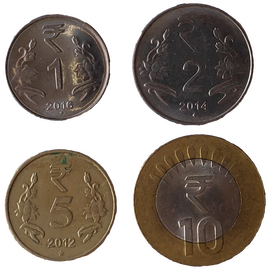
The Adventures of a Rupee
wherein are interspersed various anecdotes Asiatic and European
By Helenus Scott, 1782
The full title of my chosen work is The Adventures of a Rupee. Wherein are Interspersed Various Anecdotes Asiatic and European by Helenus Scott, published in 1782 in London, England. As the title suggests, the novel follows the adventures of a Rupee, whose consciousness begins at the beginning of time when it is but a piece of gold. Emerging from the mountains of Tibet, the Rupee describes its journey from an immobile existence, watching animals and mankind, to its realization of its own worth to human beings and the impact of this perceived value upon their relationships. The Rupee, while possessing an absurd facility for reason, is otherwise as stationary as a Rupee should be, and only moves through the world only at the will of its "masters."Adventures follows a popular trend of 18th century British writing known as "it-narratives," "object-narratives," or "novels of circulation." In these stories, the narrative follows the perspective of an inanimate object, such as a coin, as it moves through society. This often has the effect of representing human society through a humorous or satirical light, as the inanimate narrator critiques human behaviour as it can only be seen when nobody else is around. Other works from this genre include Chrysal, or the Adventures of a Guinea (1760) by Charles Johnstone and The Adventures of a Hackney Coach (1781).What strikes me most about Adventures is the eternality of the Rupee as it is revealed through the narration in the novel's early chapters. The Rupee recalls its various forms prior to becoming what it is understood to be by the end of the novel's first chapter. It discusses its transformation from an “ignoble lump of earth” (1) who spent many centuries ignorant of human beings, to becoming the “God of Gold” (10) worshipped by the Persians. Without even declaring belief in its own power, the Rupee establishes the sheer impact of arbitrary value given by humans upon its usage and perception. From the beginning, the reader is encouraged to understand that the Rupee’s power is not inherent, but projected by humans. The unfolding narrative therefore becomes not only an entertaining account of human life, but also a critique of human perception of worth, and the structures that elevate inanimate matter into objects of reverence.
The typography of the novel is standard, as it uses a single font and conventional capitalization of proper nouns, as well as the "long s" typical of writing from this time period. The novel is also divided into multiple short chapters without elaborate or decorative ornaments. The title page, however, is quite ambitious. “The Adventures of a Rupee” is followed by the subtitle “wherein are interspersed various anecdotes Asiatic and European,” which immediately signals to audiences the geographical breadth of the novel, and seemingly promises a wide range of settings and movement. Beneath this subtitle appears a quote from The Merchant of Venice by William Shakespeare: “For who shall go about to cozen fortune, and be honourable without the stamp of merit?” and “Let none presume to wear an undeserved dignity.” This preemptively frames the narrative around issues of merit and the acquisition of wealth. In addition to this, the back of the cover page includes a Latin quote from Lucretieus’ De Rerum Natura (Book II), which describes the pleasantness of observing storms and battles from a place of safety, when you have no share in the danger (King). Similarly to Lucretius’ observer, the Rupee watches quarrels and other dangerous events occur without participating in them. This quote therefore enforces the novel’s moral distance and detached perception, shaping what might otherwise appear to be a whimsical object-narrative into something aligned with classical philosophical reflection on human folly as well.Paratextual material in the novel includes a preface which declares that it is not the modern author’s place to judge Scott's work, as the modern author “corrupt[s] all true philosophy” and mistakes his “disordered notions for eternal truths.” Scott rejects all connection to these other authors, citing their obscuring of reason and preoccupations with nonsense as the reasons for distancing himself. This preface reinforces Adventures as being, at least in its own author's eyes, more serious than other contemporary works, and that the Rupee is observant of human nature in a manner that is not merely frivolous.Stylistically, the narration is largely plain and detached as the Rupee falls into new hands without strong sentiment and without forming loyalties to its masters. It rarely provides strong emotional judgments, even in instances of high stakes conflicts or in the presence of controversial masters. At times, however, the Rupee aggrandizes itself by emphasizing its age and eternality, contrasting its own immobility and lack of inherent value with the intensity of human reaction to it. This contrast produces irony, as the Rupee knows its own history and durability yet its self-importance is always defined on human perception rather than this intrinsic merit. The result is a kind of "bird’s eye" or "objective" view of mankind. The Rupee praises humanity’s achievements but remains uninvolved in humanity's greed and ambition, thereby highlighting the silliness of human conflict and monetary obsession.The choice of a Rupee as a narrator is particularly significant when situated within Britain's 18th century imperial economy. By the 1700s, the East India Company, for which Helenus Scott worked as a surgeon, had grown so large that it dominated the global textile trade and had amassed its own army to protect its commercial interests. As the Company expanded, wealth generated in and taken from India circulated back to Britain, which contributed to the economic conditions that would help begin the Industrial Revolution. Thus the Rupee is not merely a protagonist, but also an embodiment of imperial circulation.
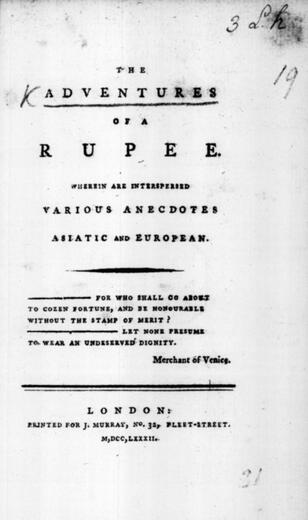
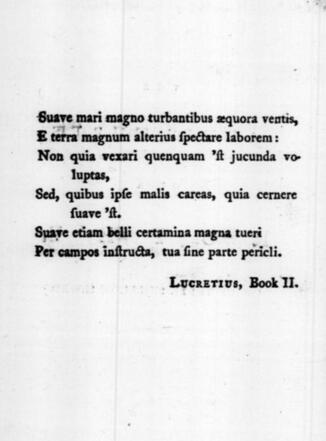
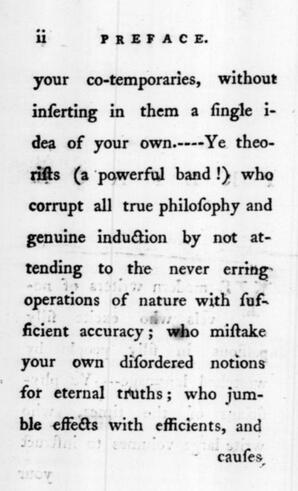
(Descending order) The Adventures of a Rupee cover, De Rerum Natura quote behind cover page, and excerpt from the preface
While I would not necessarily categorize the shift to Miss Melvil’s perspective as a flaw of the novel, I found the exploration of her narrative, especially in chapters six and seven, to be less insightful than the rest of the work. The change from the Rupee’s perspective in South Asia to a conventional human perspective in Great Britain lessens the novelty of a narrative that otherwise depends on the inanimate protagonist. I believe centering a human character's perspective removes some of the creativity of the object-narrative genre. Despite this, these chapters still contribute to the novel's broader exploration of how money impacts human relationships.I believe The Adventures of a Rupee remains worth reading today because its satire of monetary value and obsession has only become more relevant in our modern day. Modern capitalism and global trade are, in many ways, expanded versions of 18th century British mercantilism. Thus by narrating the movement of money from the perspective of a colonial era coin, Scott explores the arbitrariness of monetary systems and the human projections needed to sustain them. The Rupee’s detached and immortal perspective exposes how fleeting our ambitions appear when measured against the endurance of gold. In doing this, the novel is not only humorous, but also encourages reflection on the systems of value that govern human life.Home
Word count: 1173
In at least two releases of the General Evening Post in 1782, The Adventures of a Rupee was highly recommended by contributors to the publication. The Town and Country Magazine wrote that Adventures contains “Principles of Honour and Benevolence; and in a corrupt Age, it may be read with improvement by the young of both Sexes.” In the same advertisement, the Critical Review wrote, “we must refer to the book itself, which we may venture to recommend to [the readers] as better entertainment than cards or dice.”
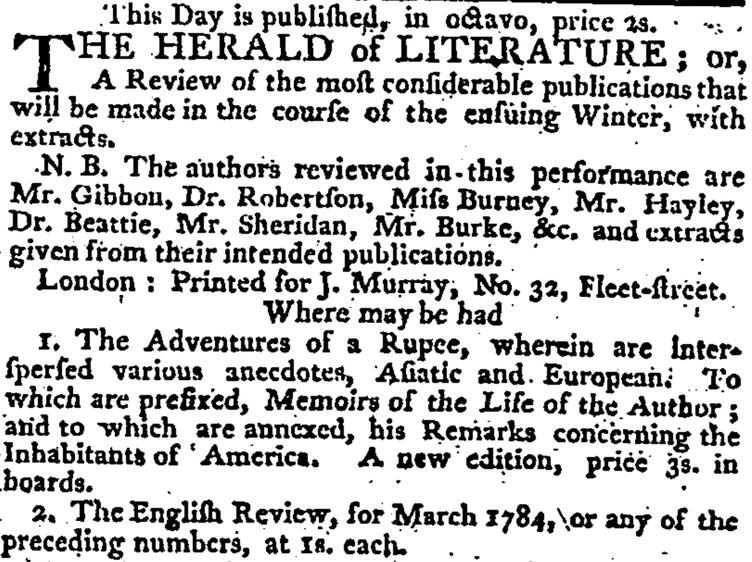
According to an advertisement found in the December 11, 1782 edition of the Morning Herald, there was a later edition of Adventures with a title and a subtitle that reads as: The Adventures of a Rupee wherein are interspersed various Anecdotes Asiatic and European. To which are prefixed, Memoirs of the Life of the Author; and to which are annexed, his Remarks concerning the Inhabitants of Africa. Below this, the Westminster Magazine describes the work as “improved” and projects that Adventures “will now grow into a higher reputation with the public.” An April 1784 edition of the Morning Chronicle also contains an advertisement for yet another later edition, which contains the author’s remarks on the inhabitants of America.Adventures continued to be advertised across multiple publications at least until the year 1784. Later advertisements did not contain reviews as older ones did, instead listing only the prices of the first or later editions.According to multiple publications, one sewed edition cost 3 shillings, while a bound copy cost 3 shillings and 6 pence. This price remained the same across several years and for later editions.Home
Word count: 272
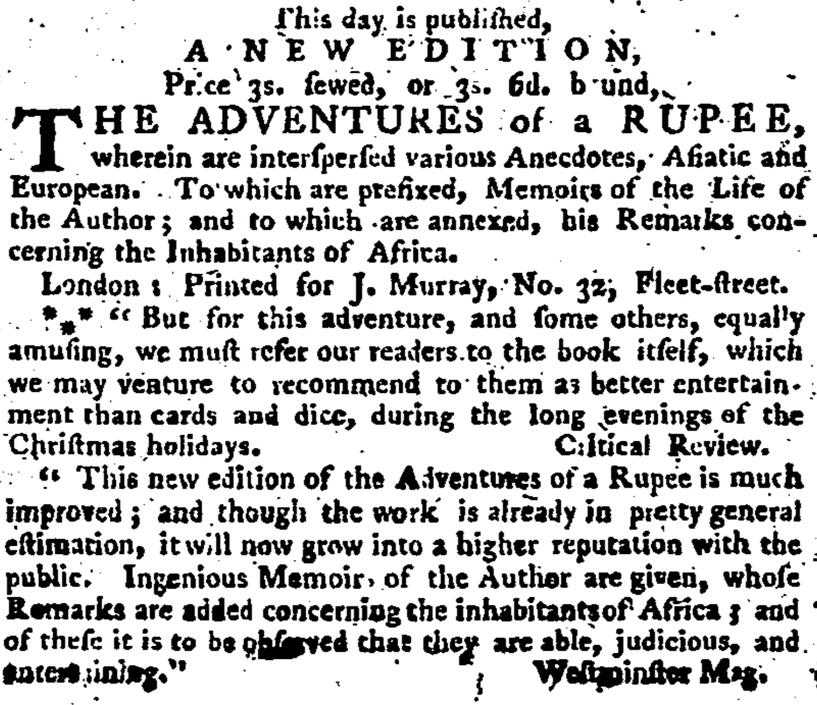
Advertisements for The Adventures of a Rupee from the Morning Herald (above) and the Morning Chronicle (below)
Helenus Scott was born in Dundee, Scotland, and was baptized on August 28th, 1758 in Auchterhouse, Forfarshire, Scotland. According to Wallis, while Scott had entered the East India Company as a normal cadet, he was commissioned as an assistant surgeon in 1783 and served mainly in the Bombay presidency. In 1801, he became a member of the Bombay medical board, and was eventually chosen as its president in 1806. Scott would work in India for 30 years before retiring from the Company in 1810, and then passing away in 1821.Scott does not appear to have ever been an active fiction writer. Besides The Adventures of a Rupee, his other known published works were medical. For example, in 1817, he contributed a paper to the Transactions of the Medico-Chirurgical Society on the medicinal use of nitromuriatic acid (Wallis). Thus, in terms of specialization, Scott does not seem to have centered the majority of his work around the object-narrative genre, nor built a notable reputation as a fiction writer in general. While the numerous advertisements and reviews for Adventures in the mid-1780s imply that the novel reached a reasonably wide audience, the lack of any further fictional works suggests that Scott never became a prolific literary figure, and that Adventures was not part of a sustained career in literary fiction.Scott’s work background, however, is not irrelevant to the novel. According to Wallis, Scott's “extensive Indian connection and reputation in the treatment of hepatic disease soon gave him a large practice.” This detail is important given that Adventures is centered on a unit of Indian currency, the Rupee, which moves between Asiatic and European settings. Scott’s experience working in colonial India may have allowed him to explore such varying geographical locations in his novel, and given him knowledge on the circulation of wealth between India and Britain.
Adventures was published by John Murray of 32 Fleet Street, a Scottish publisher and first of the Murray publishing family. By the late 1700s, Fleet Street had long been known as a publishing centre, meaning that Adventures was integrated into an already active commercial print network (Ford). Besides Adventures, Murray was also responsible for publishing various more widely known works such as Charles Darwin’s On the Origin of Species, Jane Austen’s Emma, Arthur Conan Doyle’s The Adventures of Sherlock Holmes, and Lord Byron's Childe Harold's Pilgrimage (“John Murray”).

Portrait of John Murray
The price of 3 shillings for a sewed copy and 3 shillings and 6 pence for a bound copy places Adventures in the moderately priced range for this time period. It was not so cheap as to be considered purely for the downmarket, but neither was it an expensive multi-volume work aimed exclusively at elite collectors (Eliot). By comparison, multi-volume popular novels often cost substantially more, with some exceeding half a guinea, placing them beyond casual purchase (Hume).Home
Word count: 467
The Adventures of a Rupee seems to have received mixed reception following its publication in 1782. Positive reviews tended to emphasize the novel’s moral and instructive qualities. For example, an advertisement from the Town and Country Magazine reprinted in the General Evening Post described it as containing “Principles of Honour and Benevolence; and in a corrupt Age, it may be read with improvement by the young of both Sexes.” Similarly, the Critical Review recommended the work as “better entertainment than cards or dice.” The Monthly Review, as can be seen in the image, also praised the novel for being “written to [show] how a wise man can excite wise passions by excellent language!” Across all of these positive reviews, the emphasis falls heavily on the possibility for moral reflection by its readers, and the novel itself as a respectable piece of entertainment. Adventures also appears to have been understood less as a sensational narrative and more of a philosophical narrative that could aid in the betterment of its readers.This positive reception should also be understood within the broader context of attitudes and anxieties toward novel reading in the 18th century. During this period, novels were often accused of encouraging laziness or moral corruption within readers, especially younger readers and women. Many worried that fictional works blurred the line between reality and imagination, and would thus distract readers from other more "noble" pursuits (Ward). Therefore the praise directed at Adventures centres around its improving qualities, which sets it apart from the perception of many other works at the time.
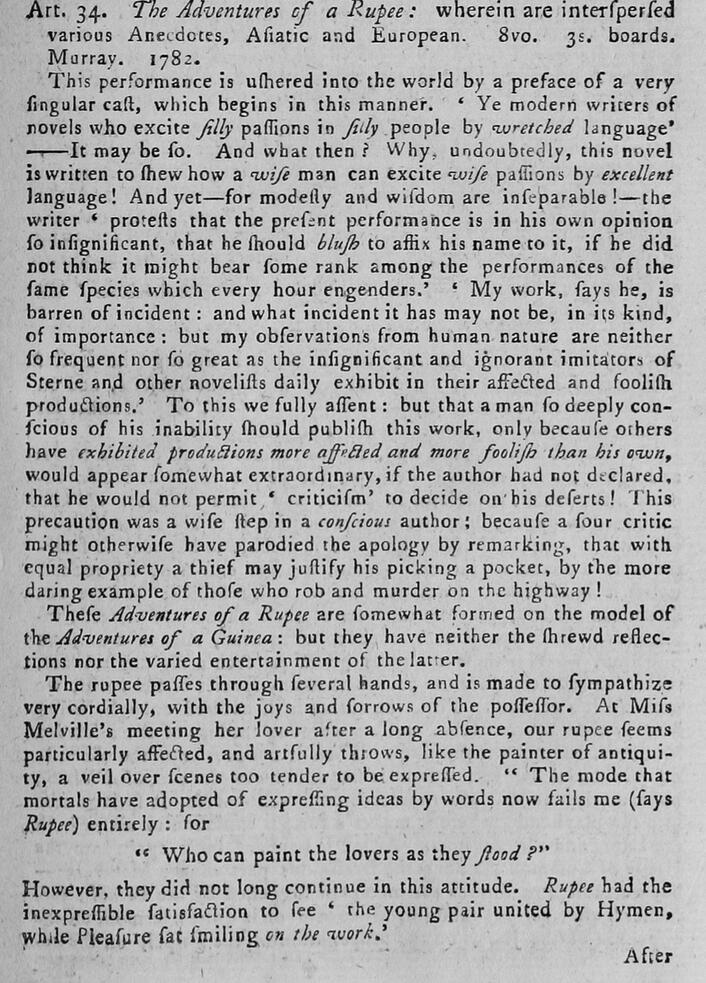
Review of The Adventures of a Rupee from the Monthly Review
Negative reception, by contrast, focused on the seeming lack of narrative intensity in the novel. In The Critick, published in the Whitehall Evening Post in 1782, a reviewer asked, “Why dignify the dull incidents of common life with the title of Adventures!” This either suggests disappointment with the pacing of Adventures itself or perhaps even with the object-narrative genre as a whole. In an era when the term "adventures" in a title usually promised sensation, Scott’s more observational story may have been seen by many as unsatisfying. The mixed reception thus reflects the tensions in the late 1700s marketplace, as readers were encouraged to engage with narratives which contained proper moral instruction, but also naturally sought novelty and excitement.Home
Word count: 378
The rupee has a long history in South Asia that predates British colonial presence. The word comes from the Sanskrit rupya, meaning “wrought silver” (Britannica). Even long before the arrival of European traders, India had already possessed a developed monetized economy, as gold, silver and copper coins with multiple systems of denominations had been in use across the subcontinent for more than two thousand years (American Numismatic Association). Under the Mughal Empire, founded in 1526 by the Timurid dynasty, a standardized monetary system helped enable trade across much of India during the 16th and 17th centuries. Thus the Mughal rupee, in particular, became a widely recognized and stable unit of currency.
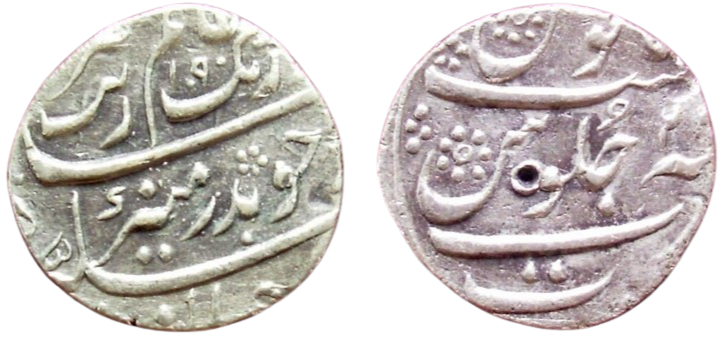
European trading companies entered this already developed monetary system in the 17th century. The British East India Company, chartered in 1600 by Queen Elizabeth I, adapted to these existing systems (Morrison). In 1671, the Company had begun minting coins which were modelled on local types, and adopted the rupee as its basic unit of account, along with the Portuguese and the Dutch. By the year 1677, the Company had grown so influential that King Charles II granted it the right to mint its own coins in the territory of Bombay (CoinWeek). However, these European style coins would prove to be unpopular, and thus Indian coins continued to dominate circulation. By the late 17th century, when the Mughal Empire was beginning to weaken, the East India Company increasingly struck Mughal style coins. By the late 18th century, when The Adventures of a Rupee was published, the Company had already begun introducing mechanical coining techniques in India, marking the beginning of a transition toward a more standardized colonial coinage system (The Editors of Encyclopaedia Britannica). Even since gaining its independence in 1947, India uses the rupee as its form of currency to this day.Home
Word count: 302
American Numismatic Association. “Money of the British East India Company - American Numismatic Association.” American Numismatic Association, 26 July 2023, www.money.org/money-museum/virtual-exhibits-moe-case11. Accessed 4 Mar. 2026.CoinWeek. “The East India Company and Its Coins.” CoinWeek: Rare Coin, Currency, and Bullion News for Collectors, 8 Jan. 2024, coinweek.com/the-east-india-company-coins. Accessed 4 Mar. 2026.“The East India Company and Its Role in Ruling India - Historic UK.” Historic UK, 27 Nov. 2023, www.historic-uk.com/HistoryUK/HistoryofEngland/The-East-India-Company. Accessed 4 Mar. 2026.Eliot, Simon. “From Few and Expensive to Many and Cheap.” The British Book Market 1800–90, Aug. 2019, pp. 471–84, doi:10.1002/9781119018193.ch31.Ford, Harry. Fleet Street. mapoflondon.uvic.ca/FLEE6.htm.Hume, Robert D. “The Value of Money in Eighteenth-Century England.” Huntington Library Quarterly, vol. 77, no. 4, Dec. 2014, pp. 373–416, doi:10.1525/hlq.2014.77.4.373.“John Murray.” Hachette UK, 14 Jan. 2025, www.johnmurraypress.co.uk. Accessed 4 Mar. 2026.King, Dean. A Sea of Words. 3rd ed., 2000.Morrison, Jean. “East India Company.” The Canadian Encyclopedia, thecanadianencyclopedia.ca/en/article/east-india-company. Accessed 4 Mar. 2026.Rodriguez McRobbie, Linda. “How Novels Came to Be Written in the Voice of Coins, Stuffed Animals and Other Random Objects.” Atlas Obscura, 12 May 2016, www.atlasobscura.com/articles/how-novels-came-to-be-written-in-the-voice-of-coins-stuffed-animals-and-other-random-objects. Accessed 4 Mar. 2026.The Editors of Encyclopaedia Britannica. “rupee.” Britannica, www.britannica.com/money/rupee. Accessed 4 Mar. 2026.Wallis, Patrick. “Scott, Helenus.” Oxford Dictionary of National Biography, 23 Sept. 2004, www.oxforddnb.com/display/10.1093/ref:odnb/9780198614128.001.0001/odnb-9780198614128-e-24873?rskey=og9HY0&result=1. Accessed 4 Mar. 2026.Ward, Richard. “Print Culture, Moral Panic, and the Administration of the Law : The London Crime Wave of 1744.” Crime Histoire Et Sociétés, vol. 16, no. 1, May 2012, pp. 5–24, doi:10.4000/chs.1317.Home